## What is even this task about? Ok, so last time we ended up with some bunch of weird looking bytes; > 00 00 00 00 0e 05 13 07 36 0f 37 69 22 27 3f 65 2e 20 36 69 2f 3b 3f 24 26 61 2c 21 24 3a 7b 65 7d 39 6a 79 7d 79 6a 38 4d 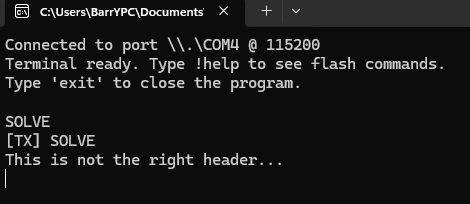 Attempt to **SOLVE**...
>/Posts/[7:12]/25 $
2026

20 Feb

## What's that? Because I need to practice my skills in IoT and physical security of electronic devices, I decided to buy the Sword of Secrets hardware crypto CTF kit, which recently arrived. If you don't know what that is, don't worry you haven't missed anything important. In this post I'll...
19 Feb
## Introduction Quite a few of my posts focus on solving challenges involving reverse engineering of mobile applications from CTF competitions. Although in one of my previous posts I briefly described how to approach this topic, I'd like to cover it more extensively here, highlighting...
3 Feb
2025

# Requirements To create an account, you'll need the **Authenticator** app or any other that supports TOTP (time-based one-time passwords), since I don't want to store this kind of information in my database. :) ## What's next? Once you have it, go to the [sign-up](/sign-up) page and check if...
16 Feb
2024
## The Discrete Logarithm Problem Now that you understand modular arithmetic, we can move on to its applications. In the previous post, we discussed how to perform modular computations. Now, it's time to learn how these computations are used in cryptography. Calculating the remainder in an...
21 Aug
# What is Modular Arithmetic? Usually, when you want to perform division, you do something like: $$ \frac{3}{5} = 1,(6) \Rightarrow 1\frac{2}{3} $$ But there are some cases when you only need the remainder. $$ \frac{\text{Dividend}}{\text{Divisor}} = \text{Quotient} + \text{Remainder}...
14 Aug
X